The best way to learn Spanish as an adult
Adults don't learn worse than kids. They have less time and less patience for feeling silly. The fix is a method built around speaking, in small daily doses.

Updated November 21, 2026 | 7 min read
Contains affiliate links. How we make money
Start with your reason
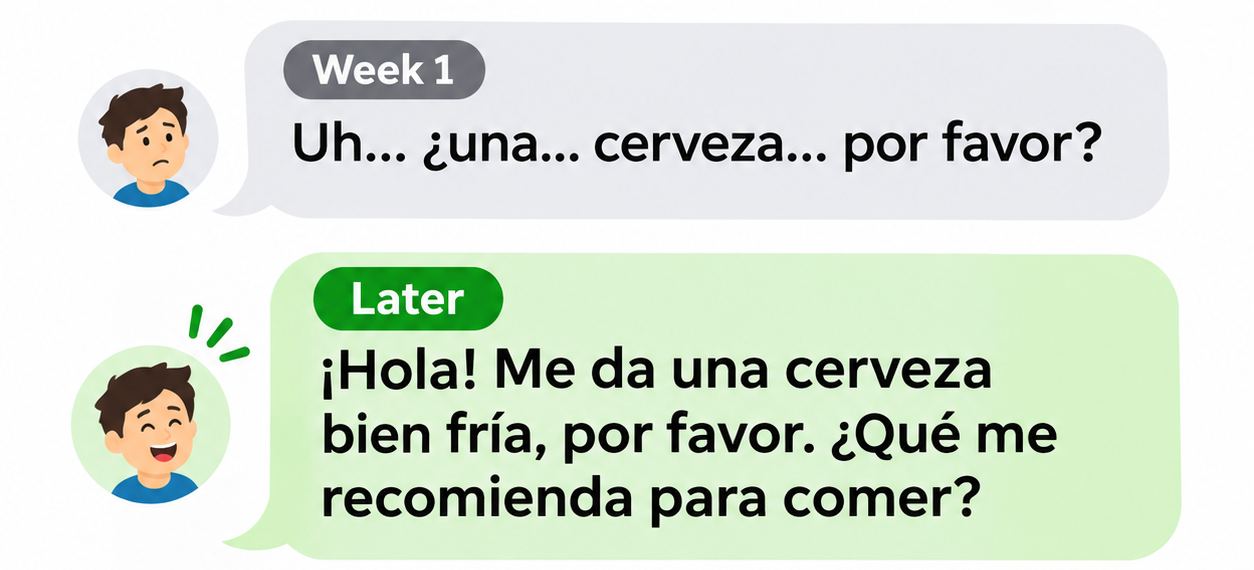
"Learn Spanish" is too big to finish. "Order dinner and ask for directions in Mexico City in March" is not. Your reason decides what you learn first: travelers need food, transport and numbers; nurses need body parts and questions; parents need everyday family talk.
Write one sentence: who you want to talk to, about what, by when. Pick lessons that serve it and skip the rest for now.
What works for adults
Listen before you read
Spanish spelling is regular, but real speech is fast. Hearing native speakers early trains your ear and stops you building a "reading accent."
Say everything out loud
Silent study builds recognition. Speaking builds recall, which is what a conversation needs. Repeat each new phrase, then use it in a sentence about your own life.
Learn chunks, not single words
"¿Me puede ayudar?" (Can you help me?) is more useful than knowing "ayudar" on its own. Phrases come with the grammar built in.
Get feedback on your pronunciation
A tutor, a native-speaker friend or a course with voice recognition all work. What matters is that something tells you when "pero" (but) comes out as "perro" (dog).
Review what you get wrong
Spaced repetition, where tricky words come back just before you'd forget them, is one of the best-studied memory techniques. Most good apps and courses use it.
A 20-minute daily routine
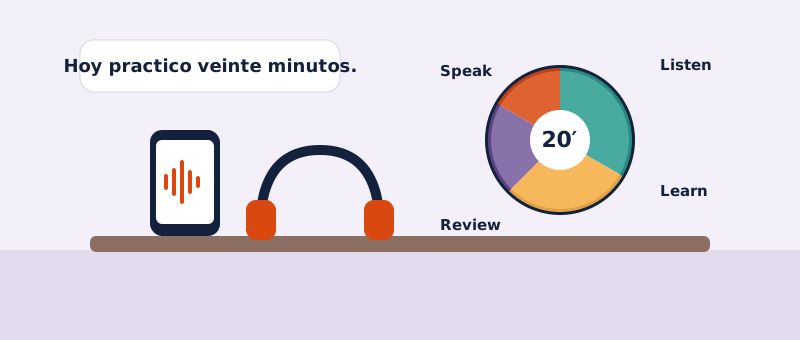
- 5 minutes: listen to a short dialogue and repeat each line out loud.
- 8 minutes: one new lesson or grammar point.
- 4 minutes: review flashcards or your course's review activity.
- 3 minutes: say three sentences about your day in Spanish.
Once a week, swap the routine for 30 minutes of real conversation: a tutor, a language exchange or a Spanish-speaking friend.
Which tools to use
| Tool | Good for | Watch out for |
|---|---|---|
| Free apps | A daily habit, vocabulary | Little real speaking |
| Structured courses | A clear path, audio, speaking practice | Paid, self-study |
| Online tutors | Live conversation and feedback | Cost per hour adds up |
| Podcasts and TV | Natural-speed listening | Hard for beginners without subtitles |
Many people combine a structured course for the daily routine with a weekly conversation. If you want a course that focuses on speaking, read our Rocket Spanish review.
Try a speaking-first course for free
Rocket Spanish has a free trial with no credit card required.